
Why does yoga sometimes hurt instead of heal? Many beginners feel lower back or knee pain within the first weeks of practice. Small alignment errors often build pressure long before real strength develops. That is why learning how to Fix Common Yoga Mistakes For Beginners is essential for safe progress. When posture, breath, and joint positioning improve, the body responds with better stability and less strain. Yoga should build resilience, not create preventable injuries. Keep reading to discover the specific mistakes that may be holding your practice back and how to correct them safely.
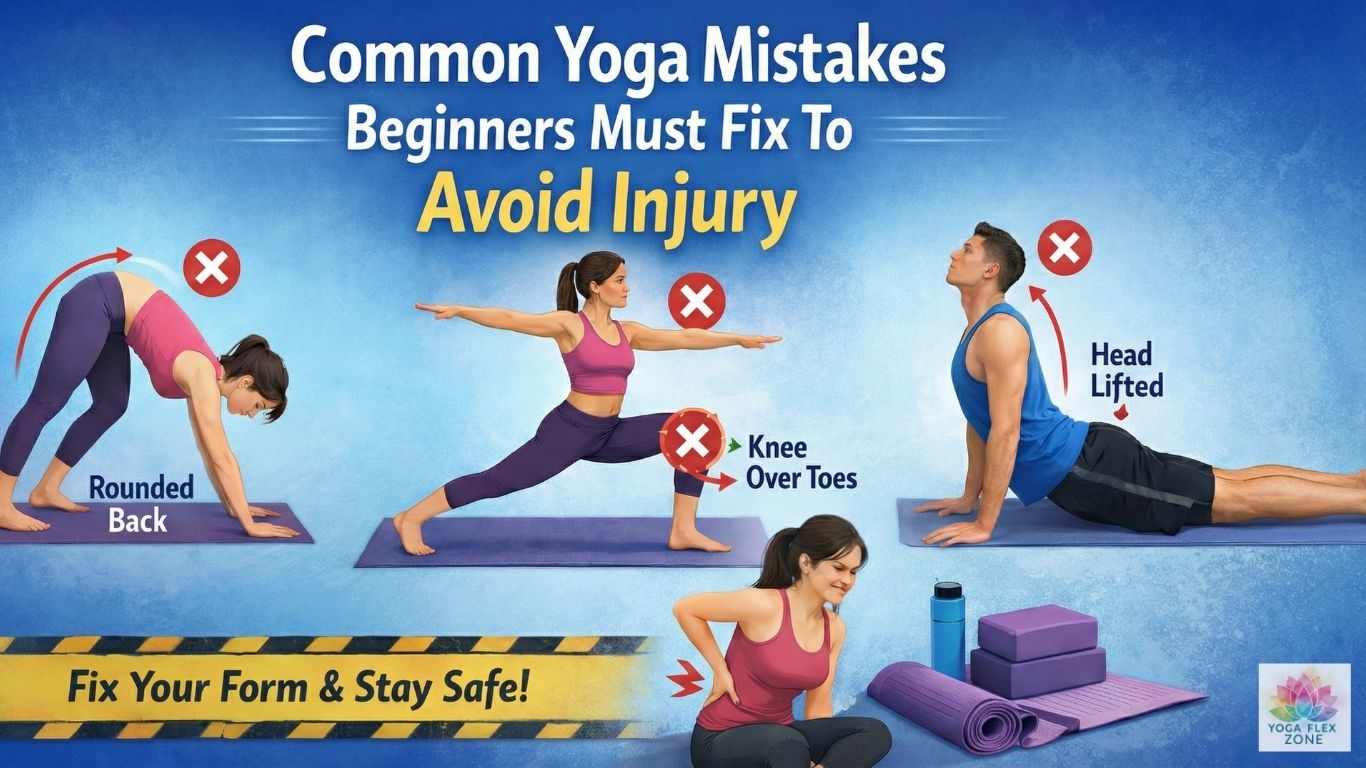
Common Yoga Mistakes Beginners Must Fix To Avoid Injury
Beginners often feel pain in yoga due to poor awareness and rushed movements. Small alignment mistakes slowly create tension inside the body. Ignoring early warning signs increases the risk of injury over time. A safe practice focuses on patience, mindful movement, steady breathing, and daily respect for personal limits.
Why Your Practice Might Be Causing Pain Instead Of Relief
Yoga is meant to heal the body, but improper form can quietly cause harm. Sharp joint pain often appears when alignment is slightly off. Many beginners ignore these early warning signs and continue practicing daily. Over time, this leads to chronic inflammation and stiffness.
Repetitive movements without stability can wear down cartilage and strain the spine. Following basic yoga injury prevention tips helps protect sensitive joints and muscles. Muscles also need recovery time to repair micro-tears caused by intense stretching. Rest days are essential for rebuilding strength and maintaining long-term progress.
Stop Holding Your Breath To Release Tension Instantly
Holding your breath limits oxygen supply to working muscles during movement. This common habit can raise blood pressure and trigger tension quickly. The nervous system interprets breath restriction as a stressor, preventing muscles from fully relaxing.
Deep breathing activates the parasympathetic response, calming the body naturally. It is one of the most common yoga alignment errors beginners experience without realizing it. Synchronizing breath with movement helps create ease in poses. Steady breathing also releases stored tension from the neck and shoulders.
Why Pushing Too Hard To Look Flexible Is Dangerous
Forcing the body into deep poses increases the risk of ligament and joint damage. Beginners often push past their limits due to ego or comparison. This habit places unnecessary stress on the lower back, knees, and hips.
Pushing too hard creates several risks for beginners, including:
- Overstretching ligaments that reduce joint stability
- Increased chance of lower back strain
- Ignoring pain signals that lead to inflammation
- Locking joints and limiting natural movement
- Losing mental focus during practice
True flexibility develops gradually with patience and consistency. Respecting your current range of motion supports proper yoga form for beginners. Over time, mindful practice builds strength and flexibility without forcing the body into pain.
How To Distinguish Between Discomfort And Sharp Pain
Understanding sensation is crucial for protecting your body from harm today. Discomfort usually feels like a dull ache within the muscle belly. Sharp pain feels like a sudden electric shock in your joints. Knowing the difference is one of the best beginner yoga safety tips. You must stop immediately if you feel any sharp sensations today.
| Category | Normal Discomfort | Sharp Pain |
|---|---|---|
| Sensation | Dull, broad, stretching feeling | Sharp, stabbing, electric, or pinching |
| Location | Middle of the muscle belly | Inside joints or specific points |
| Duration | Fades when the pose ends | Lingers long after practice |
| Breathing | Slow, steady, controlled | Held, shallow, or gasping |
Listen to the feedback your nervous system provides during every pose. Sharp pain indicates that you have pushed past your safe limit. Back off immediately to prevent tearing your delicate soft tissues today.
Stop Collapsing Your Shoulders In Downward Dog For Neck Relief
Collapsing your shoulders compresses the sensitive vertebrae in your neck. This pressure can irritate nerves that travel down your arms. You may notice numbness or tingling in your fingers during practice. Ignoring this strain often leads to ongoing neck tension and headaches.
Over time, shoulder compression places stress on the cervical discs. Allowing your shoulder blades to slide down your back creates space in the neck. This adjustment helps prevent rotator cuff strain and supports long-term yoga injury-prevention tips for a safer practice.
Rotate Your Arms Outward To Free Your Neck Muscles
Externally rotating your upper arms creates space across the shoulders and neck. This action activates stabilizing muscles around the shoulder girdle. It gently draws the shoulder blades away from the ears. This technique supports proper yoga form for beginners.
Step-by-Step Adjustment:
- Press evenly through your knuckles to activate your hands.
- Wrap your outer armpits slightly toward your chest.
- Slide your shoulder blades down your back.
- Let your head relax fully without gripping.
This adjustment helps the neck feel longer and lighter. The pose becomes more supportive and comfortable overall.
Rounding Your Spine In Forward Folds Causes Lower Back Pain
Rounding the spine reverses the natural curve of the lower back. This places unnecessary pressure on the spinal discs. Repeating this pattern increases irritation in the surrounding nerves. It remains one of the most common yoga alignment errors beginners make.
Tight hamstrings often pull the pelvis out of alignment. When this happens, the lower back compensates by rounding forward. Over time, this stress contributes to chronic discomfort. Maintaining spinal length is more important than reaching the toes.
Use The Micro Bend Technique To Protect Your Lower Back
Slightly bending your knees reduces tension in tight hamstrings. This allows the pelvis to tilt forward naturally. The lower back can remain neutral rather than strain. This is one of the most effective beginner yoga injury prevention tips.
- Reduces strain on the lower lumbar discs
- Allows the chest to rest more comfortably on the thighs
- Supports a long, neutral spine during forward folds
Using this technique makes forward folds feel safer and more controlled. Protecting the lower back should always come first.
Dropping Your Hips In Plank Pose Strains Your Lower Back
Planks are supposed to strengthen your core while keeping your spine supported. When the hips sink too low, the lower back arches excessively. That extra arch increases pressure on small joints and spinal discs. Over time, this added stress can lead to stiffness or lingering discomfort.
Many beginners feel lower back soreness during their first week of plank practice. Most of the time, the hips are simply dropping without them realizing it. Many beginners feel relief almost instantly when they lift their hips slightly higher. As the core muscles tire, the pelvis shifts forward, and the abdomen stops working efficiently. The lower back then takes over, even though it was never meant to carry the load alone.
Engage Your Core To Create A Perfect Straight Line
Proper core activation helps protect the spine from unnecessary mechanical stress during the plank. When the abdominal muscles and glutes engage together, they create balanced support for the lumbar region. Without this support, the lower back absorbs excess load, leading to fatigue that develops quickly.
Follow these steps:
- Press firmly through both palms to activate shoulder stabilizers
- Slightly tuck the pelvis to reduce excessive lumbar arching
- Draw the abdomen inward while breathing steadily
- Lightly engage the gluteal muscles for pelvic balance
- Keep the neck aligned with the rest of the spine
If your hips begin to sag before muscle fatigue sets in, lower your knees immediately. This adjustment reflects proper yoga form for beginners and supports effective yoga injury prevention tips.
Misaligning Your Front Knee In Warrior Poses Risks Joint Injury
Warrior poses require controlled knee tracking to protect ligaments and cartilage. When the front knee collapses inward or shifts too far forward, stress increases across the joint structures. Medial ligaments, the patellar tendon, and surrounding tissues absorb unnecessary load during poor alignment. At first it may feel stable, but that subtle inward drift builds pressure slowly.
Beginners often overlook subtle instability during deeper lunges. Repeated misalignment may contribute to irritation, inflammation, and long-term joint sensitivity. Correcting these issues early is essential when working to safely and effectively fix common yoga mistakes for beginners.
Follow The 90 Degree Rule For Maximum Knee Stability
The ninety-degree rule helps distribute force evenly across the knee joint during Warrior poses. Apply these alignment cues to maintain stability and reduce strain:
- Keep the front thigh approaching parallel to the floor
- Stack the knee directly above the ankle joint
- Maintain a vertical shin to limit forward shear
- Ground weight evenly through the heel and big toe
Engaging the gluteal muscles prevents inward knee collapse and improves control. This method reinforces beginner yoga safety tips while maintaining natural mobility and joint integrity.
Why Refusing To Use Yoga Props Slows Down Your Progress
Many beginners avoid yoga props because they believe support means weakness. In reality, props improve alignment and reduce unnecessary strain on joints and muscles. When the range of motion exceeds current strength capacity, compensation patterns develop quickly and limit safe progress.
Using blocks or straps allows gradual adaptation without forcing flexibility. This approach reduces overload on the lower back and hamstrings. Incorporating support tools reflects proper yoga form for beginners and strengthens long-term control, rather than encouraging unstable movement patterns.
How Using Blocks Helps You Go Deeper Without Strain
Yoga blocks create stability while maintaining correct joint alignment. They allow safe depth without collapsing into passive flexibility.
Key benefits include:
- Reducing excessive spinal rounding in forward folds
- Supporting neutral hip alignment during standing poses
- Decreasing hamstring tension in limited mobility
- Improving balance and confidence in challenging positions
Using props strategically supports yoga injury-prevention tips while gradually building strength.
Skipping The Essential Warm Up Leads To Muscle Strain
Cold muscles lack optimal elasticity and coordinated activation. Beginning intense stretching without proper preparation increases the risk of microtears in muscle fibers. Adequate warm-up improves blood circulation and enhances neuromuscular coordination before load-bearing poses. Many beginners notice their movements feel smoother after just a few minutes of preparation, slowly.
Dynamic preparation movements gradually raise tissue temperature and improve joint lubrication. This process allows muscles to contract and lengthen more efficiently. Skipping this step remains a common cause of preventable strain in early-stage practitioners.
How To Build A Safe And Consistent Daily Yoga Habit
Consistency matters more than intensity for sustainable progress. Start with manageable sessions lasting ten to fifteen minutes daily. Gradual progression allows tissues to adapt without overwhelming joints or connective structures.
To build a stable routine, follow these practical guidelines:
- Schedule practice at the same time each day
- Include at least one structured rest day weekly
- Increase difficulty gradually instead of abruptly
- Stop immediately if sharp joint pain appears
This approach reinforces beginner yoga safety tips and supports long-term physical resilience.
FAQs
What are the most common yoga mistakes beginners make?
Answer: The most common yoga mistakes beginners make include dropping hips in plank, misaligning knees in lunges, and holding the breath during effort. These issues often develop from weak stabilizing muscles and limited body awareness. Learning to fix these mistakes improves alignment and long-term joint safety.
How can beginners prevent injuries during yoga practice?
Answer: Beginners can prevent injuries by focusing on controlled movement rather than deep stretching. Maintaining neutral spinal alignment, warming up properly, and stopping when sharp pain appears are essential yoga injury prevention tips that protect joints and connective tissues.
Is it normal to feel pain during yoga?
Answer: Mild muscular discomfort can be normal when building strength or flexibility. However, sharp, stabbing, or joint-centered pain is not normal. That type of pain usually signals poor alignment or excessive load and should be addressed immediately.
Why does my lower back hurt during the plank pose?
Answer: Lower back pain during the plank usually occurs when the hips drop or the core disengages. This shifts stress from the abdominal muscles to the lumbar spine. Activating the core and maintaining a straight body line reduces unnecessary spinal strain.
Do yoga blocks actually help beginners improve faster?
Answer: Yes, yoga blocks help beginners maintain proper alignment while gradually building strength. They reduce unnecessary strain on tight muscles and support safer positioning. Using props consistently reinforces beginner yoga safety tips without limiting steady progress.
How important is warming up before yoga?
Answer: Warming up prepares muscles and connective tissues for movement and load. Cold muscles are less elastic and more vulnerable to strain. A brief dynamic warm-up improves circulation, coordination, and overall performance during practice.
How often should beginners practice yoga safely?
Answer: Beginners should practice three to five times per week at moderate intensity. Short, consistent sessions support recovery and gradual improvement. Allowing rest days helps muscles adapt and reduces the risk of overuse injuries.
Conclusion
Yoga should build strength and mobility without creating preventable pain. Most injuries happen from small alignment mistakes repeated over time. Dropping the hips in the plank or misaligning the knees shifts stress to vulnerable joints. These patterns develop quietly and often go unnoticed in early practice. Correcting posture early protects long-term spinal and knee health.
Consistent awareness makes a real difference in beginner yoga practice. Warm up properly, use props when needed, and respect recovery days. Progress comes from control and stability, not forced flexibility. When you fix these habits, your body responds with strength, balance, and lasting resilience.
Additional References & Trusted Sources
Disclaimer: This content is for educational purposes only and does not replace medical advice. Always consult a certified instructor or healthcare professional before starting any new yoga or exercise routine.
Reviewed & Compiled by: YOGA FLEX ZONE Editorial Team