
Whether you’re reaching for something on a high shelf, turning to look behind you, or getting up after sitting for a while, your back relies on smooth, coordinated motion throughout the day. When that natural motion gradually decreases, everyday activities can begin to feel less comfortable and more restricted. Spine mobility exercises for better back movement may improve flexibility, restore natural motion, and help your body move with greater ease. This guide covers practical exercises, a simple daily routine, and healthy habits to keep your back moving well.

Why Spine Mobility Matters More Than Most People Think
Your spine is designed to bend, rotate, extend, and stabilize your body throughout the day. Long hours of sitting, repetitive routines, and limited physical activity can gradually reduce these natural motions, making everyday tasks feel less fluid. That’s why spinal mobility exercises are commonly recommended to maintain healthy joint function and support comfortable everyday activities.
When this natural motion decreases, nearby muscles often compensate by working harder than they should. Over time, this may contribute to stiffness, reduced coordination, and a smaller range of motion. Maintaining regular mobility work helps your body move more efficiently during everyday tasks. Want to loosen tight muscles first? Read: Yoga Stretches for Upper Back Pain and Tightness.
Mobility vs. Flexibility, What’s the Real Difference?
Mobility and flexibility are closely related, but they aren’t the same. Knowing how each one contributes to healthy movement makes it easier to choose the right exercises for your goals.
| Spine Mobility | Flexibility |
|---|---|
| Joint movement | Muscle length |
| Active control | Passive stretch |
| Supports daily activities | Increases muscle elasticity |
| Whole-body coordination | Individual muscles |
Both qualities work together to keep your body functioning well. While flexibility focuses on muscle length, spinal flexibility becomes more useful when paired with good joint control and coordinated motion.
Everyday Signs Your Spine Isn’t Moving Well
Your spine gradually loses mobility rather than becoming stiff overnight. Small changes in the way you bend, twist, or move can be early signs that it’s time to add more mobility work to your routine.
- Feeling stiff after sitting for long periods.
- Difficulty twisting your upper body comfortably.
- Limited forward or sideways bending.
- Rounded posture during everyday activities.
- Walking feels less smooth than usual.
- Reduced range of motion during daily tasks.
Recognizing these changes early makes it easier to restore natural movement before stiffness begins affecting your everyday routine. Wake up feeling stiff? Read: Morning Stretches for Lower Back Stiffness.
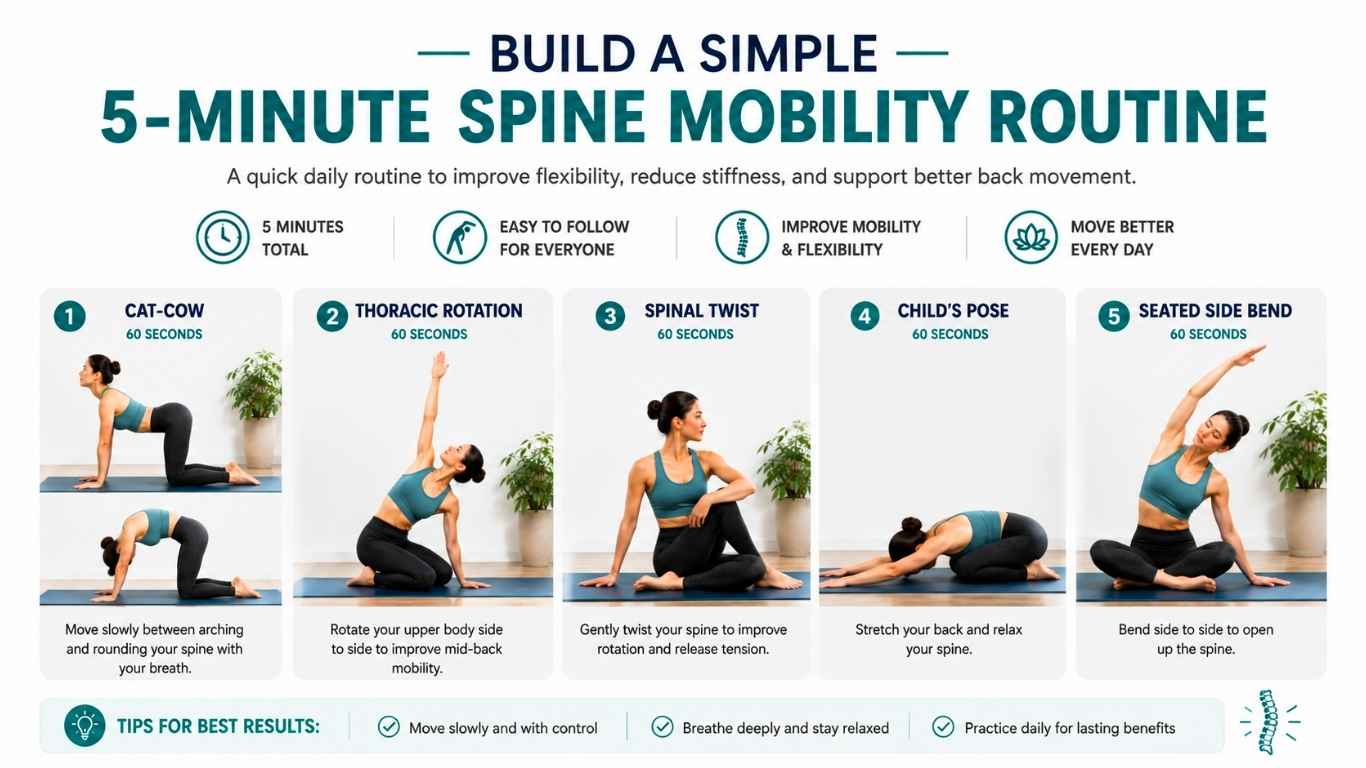
Build a Simple 5-Minute Spine Mobility Routine
You don’t need an hour-long workout to keep your back moving well. A short, structured routine that combines different movement patterns can fit easily into your morning, a work break, or your warm-up before exercise. Just five minutes of regular practice helps build consistency and encourages smoother movement throughout the day.
5-Minute Routine
| Exercise | Duration | Primary Focus |
|---|---|---|
| Cat-Cow Flow | 1 minute | Warm up the spine |
| Thread the Needle | 1 minute | Improve rotation |
| Seated Thoracic Rotation | 1 minute | Increase mobility |
| Pelvic Tilts | 1 minute | Build spinal control |
| Repeat the exercise that feels most helpful | 1 minute | Reinforce healthy movement |
Why This Routine Works
A healthy spine is designed to bend forward, extend backward, rotate, and stabilize during everyday activities. This sequence combines those natural movement patterns in a balanced way instead of placing repeated stress on one area. Rather than relying on a single exercise, it encourages your body to work through different directions of motion, helping improve spine mobility while supporting better coordination and overall function.
While researching evidence-based rehabilitation resources and practicing this routine myself after long hours of desk work, I found that shorter, well-planned sessions were much easier to follow consistently than longer workouts. The biggest difference came from focusing on controlled technique instead of trying to move farther with each repetition. Over time, this balanced approach can support smoother everyday movement, better body awareness, and long-term spinal health.
Common Mobility Mistakes
Regular practice is important, but how you move matters just as much. Small technique errors can place unnecessary strain on your body and make each session feel less effective, even when you’re exercising consistently.
Common mistakes to avoid:
- Rushing through each exercise.
- Holding your breath during each repetition.
- Skipping a gentle warm-up.
- Forcing your body beyond a comfortable range.
- Practicing only once in a while.
After reviewing rehabilitation guidance and following a daily mobility routine myself, I noticed that slowing each repetition and staying consistent produced steadier improvements than trying to move farther every session. Give your body time to adapt, and focus on controlled, comfortable motion instead of chasing a deeper range.
When You Should See a Healthcare Professional
Although back mobility exercises can be beneficial for many people, they aren’t the right choice for every situation. If your symptoms become more severe instead of gradually improving, avoid pushing through discomfort and consider seeking medical advice before continuing your routine.
Persistent numbness, progressive weakness, pain after a recent injury, fever, or a loss of bladder or bowel control are important warning signs that shouldn’t be ignored. These symptoms may indicate an underlying condition that requires a proper medical assessment rather than continued self-directed exercise.
Clinical guidance consistently emphasizes the importance of identifying serious symptoms early. Receiving an accurate diagnosis can help determine the underlying cause, guide the most appropriate treatment, and reduce the risk of making the condition worse. Once you’ve been assessed, you can discuss when it’s safe to return to your mobility routine. Does your discomfort travel down one leg? Read: Yoga Exercises for Sciatica Pain Relief at Home.
FAQ
How often should I practice spine mobility exercises?
Most people can practice a short routine three to five times each week. Gentle daily sessions may also be suitable if the movements feel comfortable and don’t increase your symptoms. Regular practice is usually more effective than exercising only occasionally.
Can spinal mobility exercises replace stretching?
Not completely. Spinal mobility exercises focus on improving joint control and coordinated motion, while stretching mainly increases muscle length. Combining both approaches creates a more balanced routine for everyday movement.
Is it normal to feel stiff before starting?
Yes. Mild stiffness is common after sleeping, prolonged sitting, or reduced physical activity. Begin with gentle movements and allow your body a few minutes to warm up before increasing your range of motion.
How long does it take to improve spine mobility?
The timeline varies for everyone. Many people notice gradual progress within a few weeks when they perform back mobility exercises consistently and maintain healthy daily movement habits.
Should mobility exercises cause pain?
No. A light stretching sensation is generally acceptable, but sharp pain, increasing numbness, or weakness are signs to stop. If symptoms continue or worsen, seek advice from a qualified healthcare professional.
What’s the best time of day to practice?
Many people prefer practicing in the morning to reduce stiffness or after long periods of sitting. The best time is whenever you can perform the routine consistently with proper technique.
Do I need any equipment?
No. Most spine mobility routines use only your body weight and a comfortable surface such as a yoga mat or carpet. Some people prefer using a folded towel or cushion for additional support during certain movements.
Can beginners perform these exercises safely?
Yes, provided the movements are slow, controlled, and stay within a comfortable range. If you have a recent injury, severe pain, or an existing spinal condition, consult a qualified healthcare professional before beginning a new exercise routine.
Conclusion
Your spine is designed to bend, rotate, extend, and support your body throughout the day. Spine mobility exercises for better back movement help maintain those natural abilities, making everyday tasks such as reaching, walking, and turning feel smoother when performed consistently.
As someone who spends many hours working at a desk, I’ve found that a short, well-balanced mobility session is easier to maintain than longer workouts. Combining gentle spinal motions in different directions has felt more practical than repeating the same exercise, especially on busy days when time is limited.
There’s no need to force a greater range or rush your progress. Move with control, stay consistent, and pay attention to how your body responds. If you experience persistent numbness, progressive weakness, fever, or pain after an injury, stop exercising and consult a qualified healthcare professional before continuing.
📚 Evidence-Based References
This guide is based on trusted resources covering spinal mobility, therapeutic exercise, musculoskeletal rehabilitation, and healthy movement patterns.
- National Institute of Arthritis and Musculoskeletal and Skin Diseases (NIAMS)
- National Institute for Health and Care Excellence (NICE) – Musculoskeletal Conditions
- World Physiotherapy – Evidence-Based Physical Activity & Rehabilitation
- NHS – Exercise, Back Health & Physical Activity
Disclaimer: This article is intended for general educational purposes and shouldn’t replace professional medical advice, diagnosis, or treatment. If you develop persistent numbness, progressive weakness, fever, loss of bladder or bowel control, or pain after an injury, seek medical evaluation before continuing any exercise program.