
Eight hours at a desk takes a real toll. By midday, the neck feels stiff, the shoulders are creeping up toward the ears, and the lower back is already complaining. Most people just push through it. But that daily stiffness adds up faster than most people realize. Morning yoga for desk workers targets exactly the areas that suffer most from a day of sitting. A few focused poses before work change how the whole body feels by the time lunch rolls around. This guide walks through the best poses, practical habits, and a simple routine built specifically for people who sit for a living.
Why Desk Workers Often Wake Up Stiff and Tight
Most people blame the mattress. The real reason is usually what happened the eight hours before bed. A full day of sitting trains the body to hold one position. The hip flexors shorten. The upper back rounds. The neck juts forward.
By the time the workday ends, the body has spent hours locked in that shape. Sleep does not reset this. It just gives those same tight muscles more time to stiffen up. Waking up stiff is not a sleep problem. It is a sitting problem that carries over into the morning.
Common Areas of Tension for Desk Workers
Desk work creates a predictable pattern of tightness. The same areas get hit every single day.
The neck and upper trapezius take the most strain. Holding the head forward while looking at a screen puts constant load on the muscles at the base of the skull. Most desk workers carry visible tension here without even realizing it.
The chest and shoulders follow. Reaching forward toward a keyboard all day shortens the chest muscles and pulls the shoulders inward. Over time this becomes a resting posture, not just a work posture.
The hip flexors and lower back round out the pattern. Sitting keeps the hip flexors compressed all day and flattens the natural curve of the lower back. That combination is behind most of the lower back discomfort desk workers experience by afternoon.
Benefits of Morning Yoga for Desk Workers
Starting the day with movement changes everything that comes after it. A short yoga for office workers routine in the morning addresses the exact areas that desk work targets most. Here is what shifts when you make it a daily habit.
- Neck and shoulder tension loosens before work begins.
- Chest opens and shoulders stop rounding forward.
- Hips release before sitting compresses them again.
- Posture gradually improves even during long work hours.
- Afternoon fatigue hits later and feels less heavy.
A desk worker stretching routine done consistently in the morning does not eliminate the effects of sitting. It just makes the body strong enough to handle them.
6 Best Morning Yoga Poses for Desk Workers
Most yoga routines are built for general flexibility. This one is different. Every pose here was chosen because it directly counters what a full day at a desk does to the body. The shoulders, neck, hips, and lower back all get targeted in under fifteen minutes. No mat required for most of them. Just enough space to move and a few minutes before the first meeting starts.
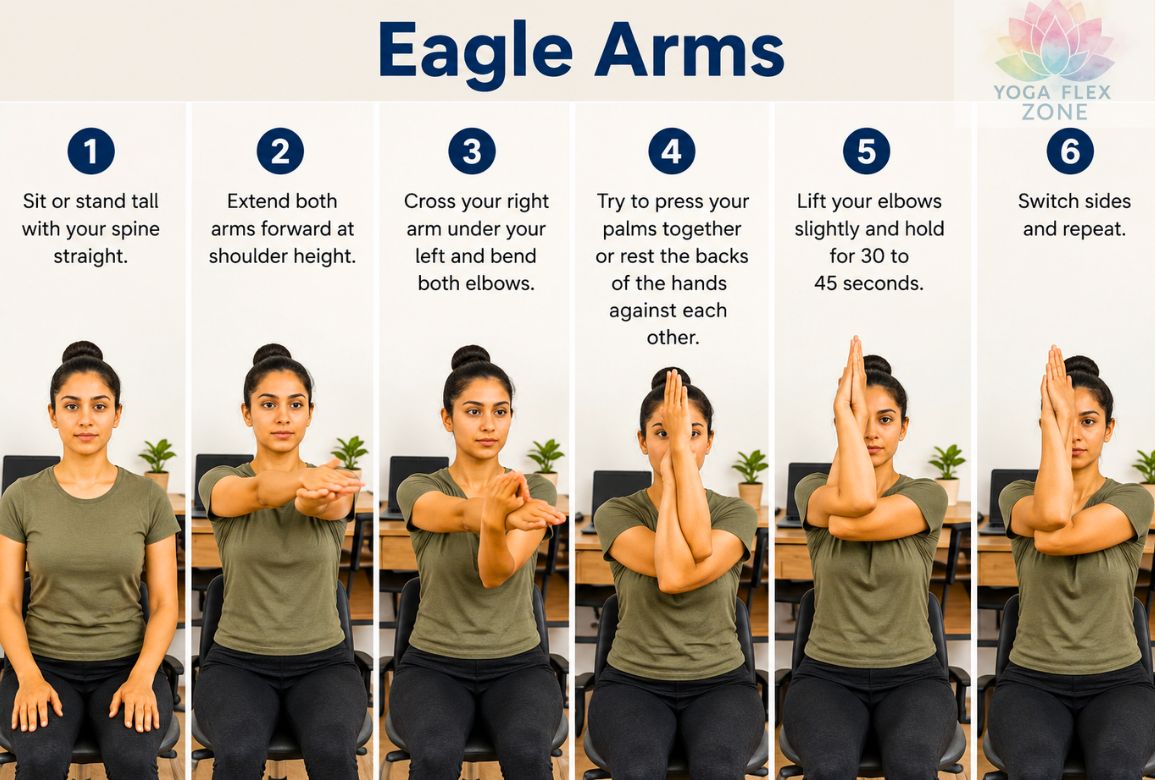
1. Eagle Arms
Desk workers carry more tension across the upper back and between the shoulder blades than almost any other muscle group. Eagle Arms reaches exactly that area. It is one of the few poses that stretches the rhomboids and rear shoulders simultaneously without any equipment or floor space.
Steps:
- Sit or stand tall with your spine straight.
- Extend both arms forward at shoulder height.
- Cross your right arm under your left and bend both elbows.
- Try to press your palms together or rest the backs of the hands against each other.
- Lift your elbows slightly and hold for 30 to 45 seconds.
- Switch sides and repeat.
Why it Helps Desk Workers
Sitting at a screen pulls the shoulders forward and compresses the upper back for hours. Eagle Arms reverses that pattern directly. The crossed arm position creates traction between the shoulder blades that no other stretch replicates. Most people feel relief in the upper back within the first hold.
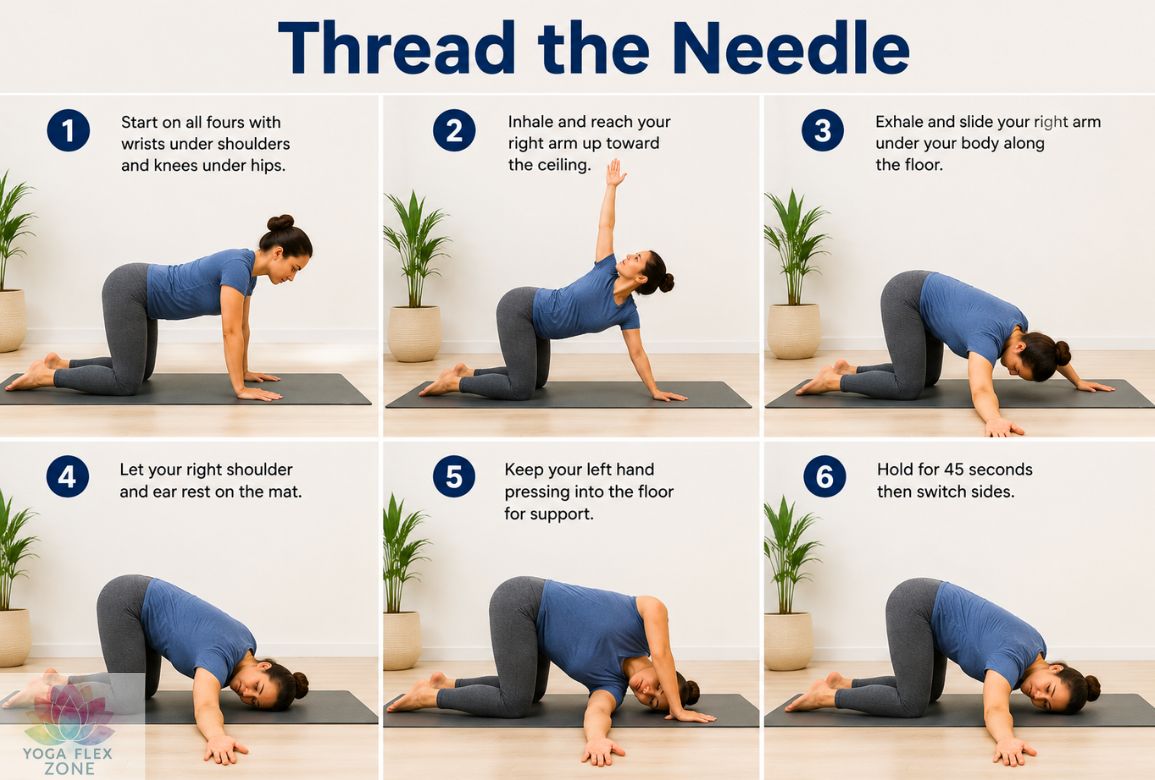
2. Thread the Needle
The mid and upper back are chronically underworked in desk jobs. Thread the Needle gets into the thoracic spine, which is the area between the shoulder blades that rounds forward during long screen sessions. Most desk workers have never felt a stretch reach this far into the upper back.
How to practice the pose:
- Start on all fours with wrists under shoulders and knees under hips.
- Inhale and reach your right arm up toward the ceiling.
- Exhale and slide your right arm under your body along the floor.
- Let your right shoulder and ear rest on the mat.
- Keep your left hand pressing into the floor for support.
- Hold for 45 seconds then switch sides.
Watch how it looks before trying: Thread the Needle Yoga Tutorial
Beginner Tips
If the shoulder does not reach the floor comfortably, place a folded blanket under the ear and shoulder. Focus on breathing slowly rather than pushing further. Let the upper back rotate naturally without forcing the range. The stretch works even without the shoulder touching the floor fully.
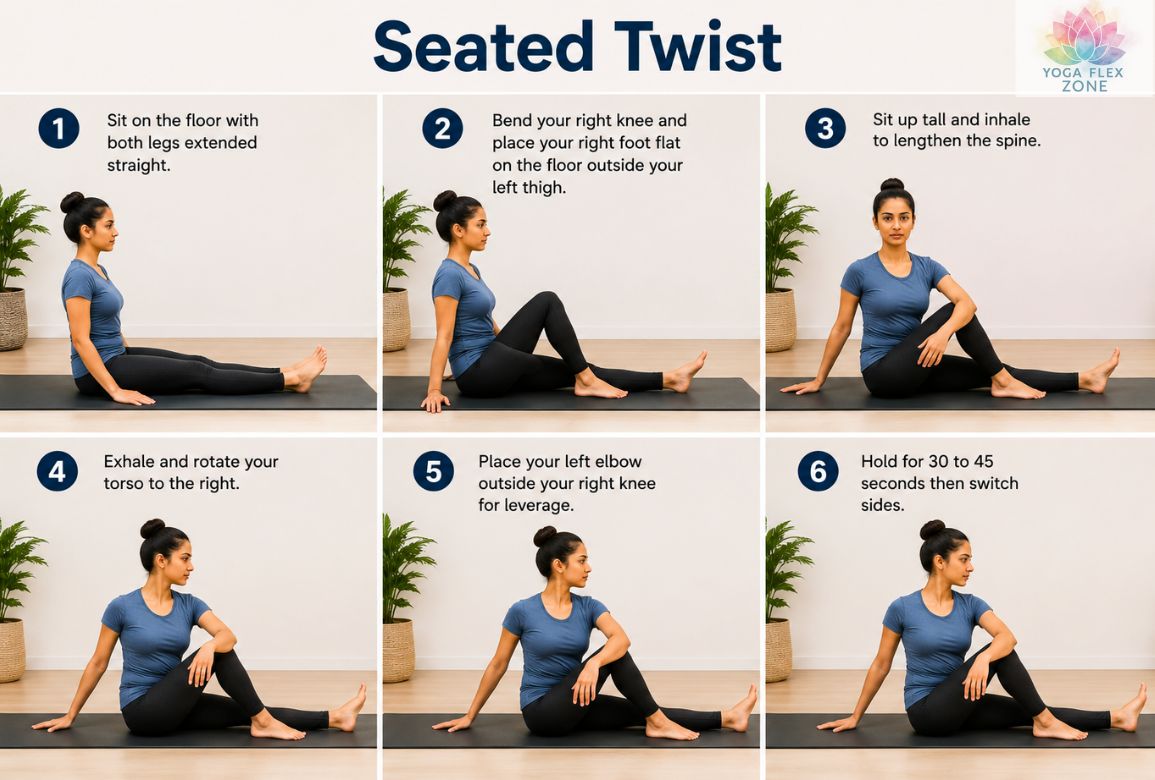
3. Seated Twist
The spine loses its natural rotation after hours of sitting in one position. Seated Twist restores that movement quickly. It also releases tension along the sides of the torso that builds up from staying locked in a forward facing position all day.
Getting started:
- Sit on the floor with both legs extended straight.
- Bend your right knee and place your right foot flat on the floor outside your left thigh.
- Sit up tall and inhale to lengthen the spine.
- Exhale and rotate your torso to the right.
- Place your left elbow outside your right knee for leverage.
- Hold for 30 to 45 seconds then switch sides.
Not sure about the setup? See it here: Seated Twist for Desk Workers
Common Adjustment
If sitting up straight on the floor feels difficult, sit on a folded blanket to raise the hips. This takes tension off the lower back and makes it easier to rotate the spine fully. The twist should come from the mid back, not just the neck.
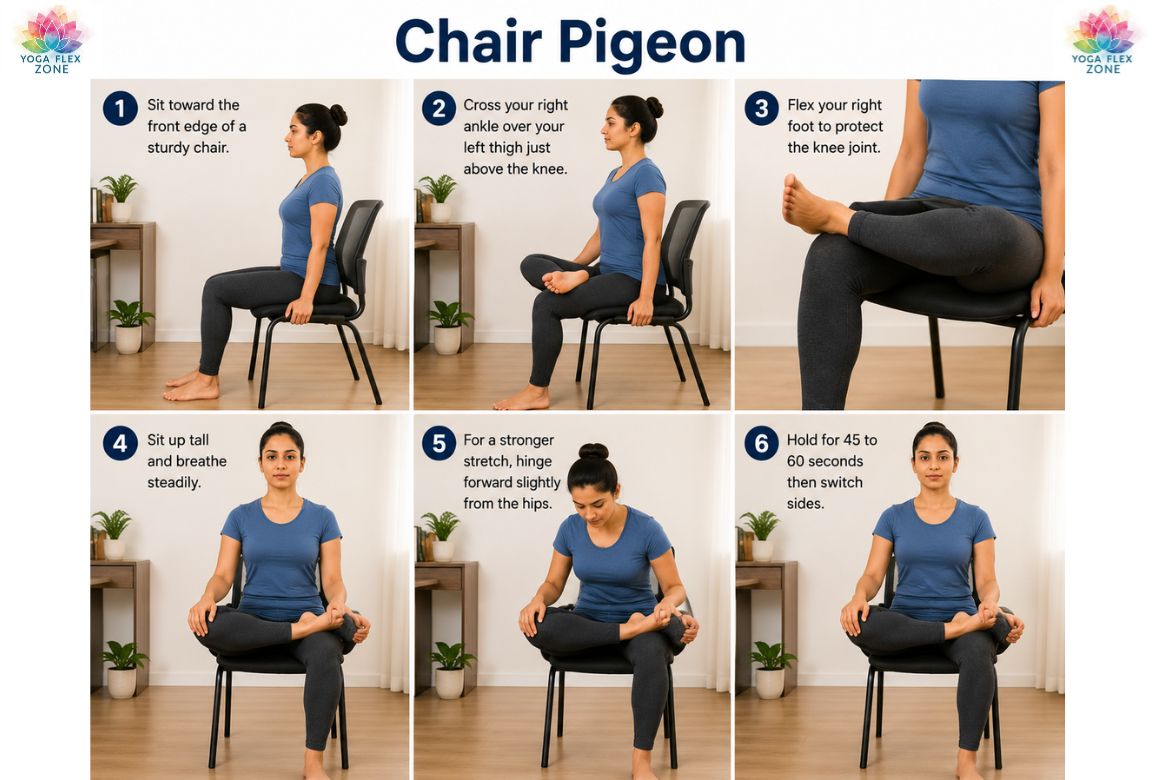
4. Chair Pigeon
The hips take a serious beating from desk work. Chair Pigeon brings the hip opening of a traditional Pigeon Pose into a seated position that works right at the desk. No mat needed. No floor required. Just a sturdy chair and sixty seconds per side.
Step-by-step instructions:
- Sit toward the front edge of a sturdy chair.
- Cross your right ankle over your left thigh just above the knee.
- Flex your right foot to protect the knee joint.
- Sit up tall and breathe steadily.
- For a stronger stretch, hinge forward slightly from the hips.
- Hold for 45 to 60 seconds then switch sides.
See the correct position here: Chair Pigeon Pose Tutorial
Safety Tip
Never force the crossed knee toward the floor. The stretch should be felt in the outer hip and glute, not in the knee joint. Keep the foot flexed throughout the entire hold. Stop immediately if discomfort appears in the knee. Anyone with existing knee issues should keep the range of motion small.
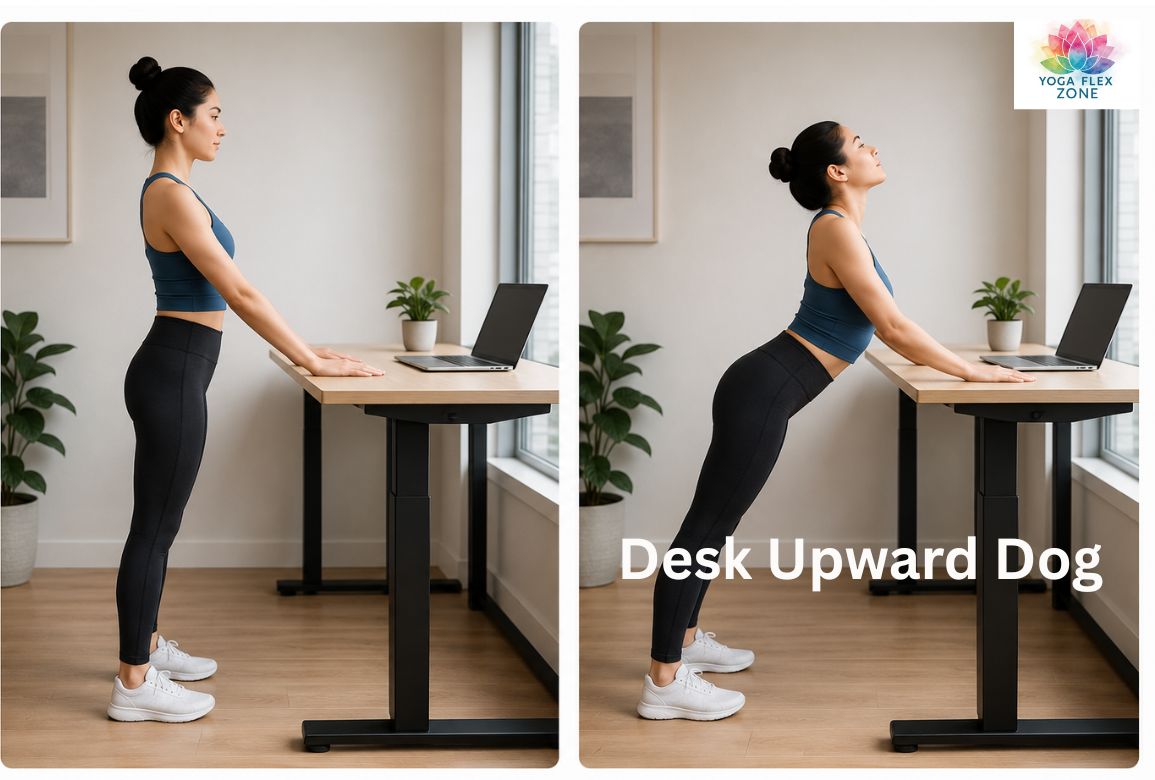
5. Desk Upward Dog
The chest collapses inward during long desk sessions. Desk Upward Dog reverses that directly. It opens the chest, stretches the hip flexors, and extends the spine all at once. It can be done standing at a desk, which makes it one of the most practical poses in any morning yoga for desk workers routine.
Performing the Stretch:
- Stand facing your desk with both hands placed flat on the surface.
- Walk your feet back until your body forms a slight diagonal.
- Lower your hips toward the desk and lift your chest forward and up.
- Press through your hands and roll your shoulders back and down.
- Keep a slight bend in the elbows rather than locking them out.
- Hold for 30 to 45 seconds and breathe steadily.
What You May Notice
The chest opens up almost immediately. Most people also feel a pull along the front of the hips, which is the hip flexor stretch engaging. If the lower back feels compressed, walk the feet slightly closer to the desk and reduce the depth of the backbend.
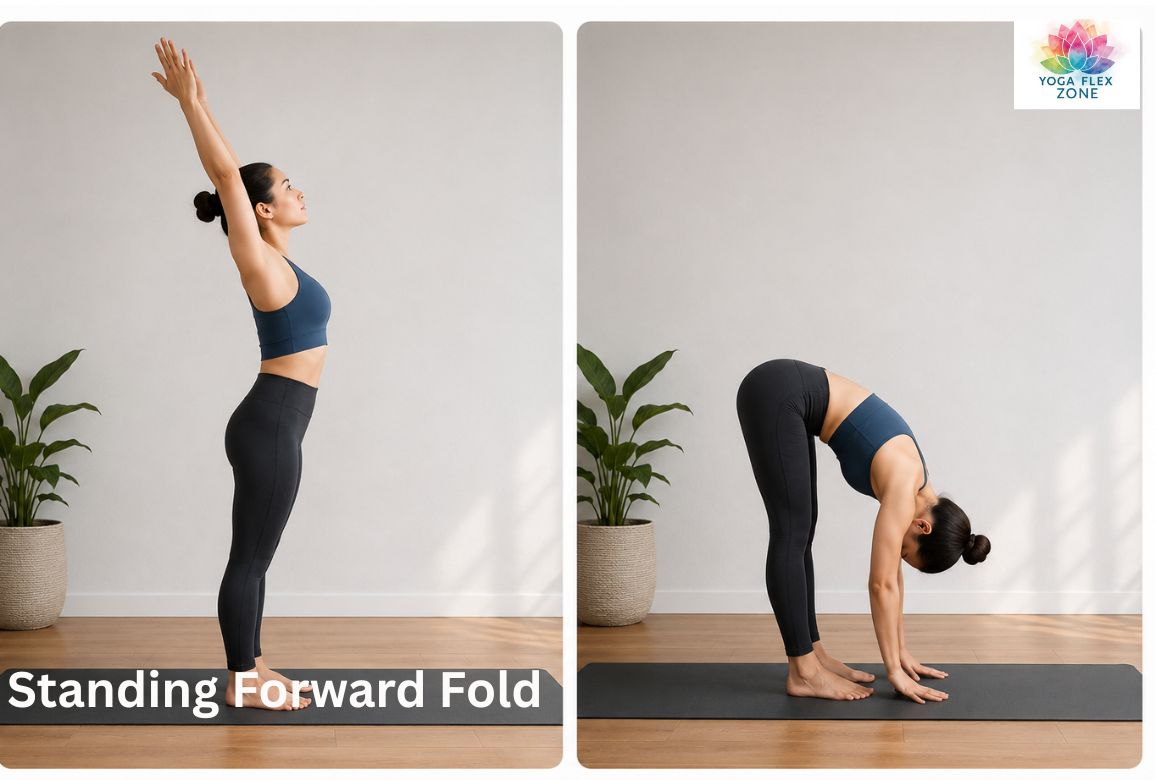
6. Standing Forward Fold
Everything tightens from the lower back down after a night of sleep following a long day of sitting. Standing Forward Fold releases the hamstrings, lower back, and calves in one simple movement. It is the most accessible pose in this entire routine and one of the most effective.
How to do It:
- Stand with feet hip width apart.
- Inhale and reach both arms overhead.
- Exhale and hinge forward from the hips.
- Let your upper body hang heavy toward the floor.
- Bend your knees generously if the hamstrings feel tight.
- Hold for 45 to 60 seconds and breathe slowly and steadily.
Common Mistakes
- Rounding from the waist instead of hinging from the hips reduces the hamstring stretch significantly.
- Locking the knees when hamstrings are tight adds strain to the joint.
- Holding the breath instead of exhaling slowly into the fold limits how much the body releases.
- Rushing out of the pose before the lower back has fully softened.
Desk Habits That Make Stiffness Worse
The morning routine helps. But certain desk habits undo that work before lunch even arrives. Most people never connect their afternoon stiffness to what they do at the desk all day.
- Sitting for over forty five minutes without moving.
- Keeping the screen too low and pushing the chin forward.
- Crossing the legs and compressing one hip all day.
- Breathing shallowly and keeping the chest tight.
- Slouching forward and rounding the upper back further.
A consistent morning movement habit builds a strong foundation. But breaking up long sitting periods throughout the day protects everything the morning session creates.
Want a quick routine you can do anytime? Read: 10-minute morning Yoga routine at home
Beginner Modifications for Tight Muscles
Starting yoga with tight muscles from years of desk work feels intimidating. Every pose in this routine has a version that works for where the body actually is right now.
Eagle Arms works even if the palms cannot touch. Resting the backs of the hands together creates the same upper back stretch. Thread the Needle does not require the shoulder to reach the floor.
Seated Twist works from a chair for anyone whose hips resist floor sitting. Chair Pigeon gets gentler simply by reducing the forward hinge. Standing Forward Fold works with a generous knee bend for tight hamstrings.
Beginners who follow a yoga for office workers routine with these modifications often move into the full versions faster than expected.
Brand new to yoga? Start here: Best Morning Yoga Routine for Complete Beginners
How Morning Yoga Supports Better Posture
Poor posture is not a character flaw. It is what happens when certain muscles get tight and others get weak from doing the same thing every day. Desk work accelerates that process faster than almost anything else.
Morning yoga for desk workers targets the exact muscle imbalances behind poor posture. The chest shortens from reaching forward all day. The upper back weakens from holding a rounded position. The hip flexors tighten from constant sitting. A short morning routine starts reversing all three before the workday even begins.
People who practice consistently often find themselves standing taller without thinking about it. The shoulders stop creeping forward. Posture improves not because of effort but because the right muscles finally have enough room to do their job.
Dealing with rounded shoulders specifically? Read: Morning Yoga for Rounded Shoulders and Neck Tension
What to Do If You Sit All Day
Sitting all day is the reality for most desk workers. The goal is not to eliminate sitting but to manage what it does to the body over time.
- Start every morning with at least five minutes of movement.
- Stand up and walk for two minutes every forty five minutes.
- Do Chair Pigeon or Eagle Arms during short breaks at the desk.
- End the workday with two minutes of gentle stretching.
A beginner morning yoga routine combined with these small habits creates a noticeable difference within the first few weeks.
Building a Sustainable Morning Movement Habit
The hardest part of any morning routine is not the movement. It is showing up consistently when motivation runs low. Most people start strong and quietly stop after two or three weeks.
The best morning yoga for desk workers works best when it becomes automatic rather than optional. Attach it to something that already happens every morning. Right after brewing coffee. Right before opening the laptop. Right after brushing teeth. This is called habit stacking, one of the most reliable ways to make new behavior stick without relying on willpower.
Start with just five minutes. Do not aim for the perfect session. Aim for the consistent one. Five minutes every morning beats thirty minutes twice a week without question. Once the habit locks in, adding more time feels natural rather than forced.
Ready to build a complete routine? Read: Complete Morning Yoga Routine for Beginners at Home
FAQ
Does morning yoga actually help desk workers?
Yes. Desk work creates predictable patterns of tightness in the neck, shoulders, hips, and lower back. A short morning yoga session targets all of these areas before the workday begins and makes a real difference in how the body feels by afternoon.
How long should someone who sits all day do morning yoga?
Ten to fifteen minutes is enough to cover all the major problem areas. Consistency matters more than duration. A short daily session delivers better results than a longer session done occasionally.
Can I do these poses at my desk?
Several of them work directly at the desk. Chair Pigeon, Eagle Arms, and Desk Upward Dog all require nothing more than a sturdy chair or desk surface. No mat or floor space needed.
How soon will I notice a difference?
Many desk workers begin noticing less tension in the neck and shoulders within the first few sessions. More significant changes in posture and hip mobility typically develop over three to four weeks of consistent daily practice.
Is morning yoga good for lower back pain from sitting?
Tight hip flexors and weak back muscles are behind most desk related lower back discomfort. A morning routine that targets both areas makes the lower back feel noticeably more comfortable over time.
Do I need yoga experience to start this routine?
No experience is needed. Every pose in this guide includes beginner modifications. Anyone who sits at a desk all day can start this routine on day one regardless of fitness level or flexibility.
What is the best single pose for desk workers?
Chair Pigeon covers the most ground since hip tightness affects everything else in the body. Eagle Arms is the best second choice for anyone carrying extra tension across the upper back and shoulders.
Conclusion
Desk work is not going away but the stiffness, tension, and poor posture that come with it are not permanent either. The best morning yoga for desk workers does not require a gym, a trainer, or an hour of free time. It requires ten minutes and the willingness to move before the laptop opens.
The six poses in this guide target every area that a full day of sitting damages most. The upper back loosens. The chest opens. The hips release. Done consistently every morning, this routine changes how the body handles a full workday from the inside out.
Referenced & Trusted Sources
- Yoga Journal — Desk Yoga
- Healthline — Sitting Effects on Body
- Harvard Health — Sitting and Health
- Verywell Fit — Office Yoga
- Mayo Clinic — Posture and Back Pain
Note: This guide is for general wellness education only and is not a substitute for professional medical advice.
Reviewed & Compiled by: YOGA FLEX ZONE Editorial Team