
Waking up stiff and achy is something most people deal with every single morning. Your hips feel locked, your back feels tight. Even standing straight takes a minute. Gentle morning yoga for a more flexible body fixes exactly that. A short session before your day starts loosens everything up your spine, hips, legs, and shoulders. You finish feeling lighter, looser, and ready to take on the day. No complicated moves, no long sessions, and no prior experience needed. This guide walks you through the exact poses and a simple routine that makes real flexibility possible, even if you’ve always considered yourself inflexible.
Why Morning Yoga Is the Best Time to Improve Flexibility
After a full night of rest, your muscles are at their tightest, especially your hips, hamstrings, and lower back. Moving through a morning flexibility routine at this exact moment teaches your muscles to release from their stiffest point. That builds a deeper range of motion faster than stretching at any other time of day.
Morning is also when cortisol levels peak. Light movement during this window works with your body’s natural chemistry reducing tension faster and shifting your nervous system out of its overnight protective mode. Many people find that regular morning yoga helps them feel less stiff and more comfortable throughout the day.
Benefits of Gentle Morning Yoga for Flexibility
Flexibility affects more than just how far you can stretch. It shapes how you move, how you feel, and how well your body holds up over years. A consistent morning yoga practice delivers real benefits — both on and off the mat.
Here is what changes when you stick with it:
- Tight muscles become easier to stretch and move
- Joint mobility improves and daily movement feels more comfortable
- Gentle poses prepare the body before the day demands anything
- Many people feel calmer and more focused after a morning session
- Flexibility develops gradually through consistent practice
The goal of increase flexibility with yoga is not to become an expert. It is simply to build a body that moves well and feels good every single day.
6 Gentle Morning Yoga Poses for a More Flexible Body
Not all yoga poses are created equal. Some are intense, some require serious skill, and some just are not built for early mornings. These six flexibility yoga poses are different. They are simple, effective, and designed to work with a stiff morning body, not against it. Each one targets a key area where tightness builds up overnight. Try working through them in order for a smooth and balanced flow.
Move slowly and listen to your body throughout the practice, especially if you feel any discomfort or stiffness.
1. Child’s Pose
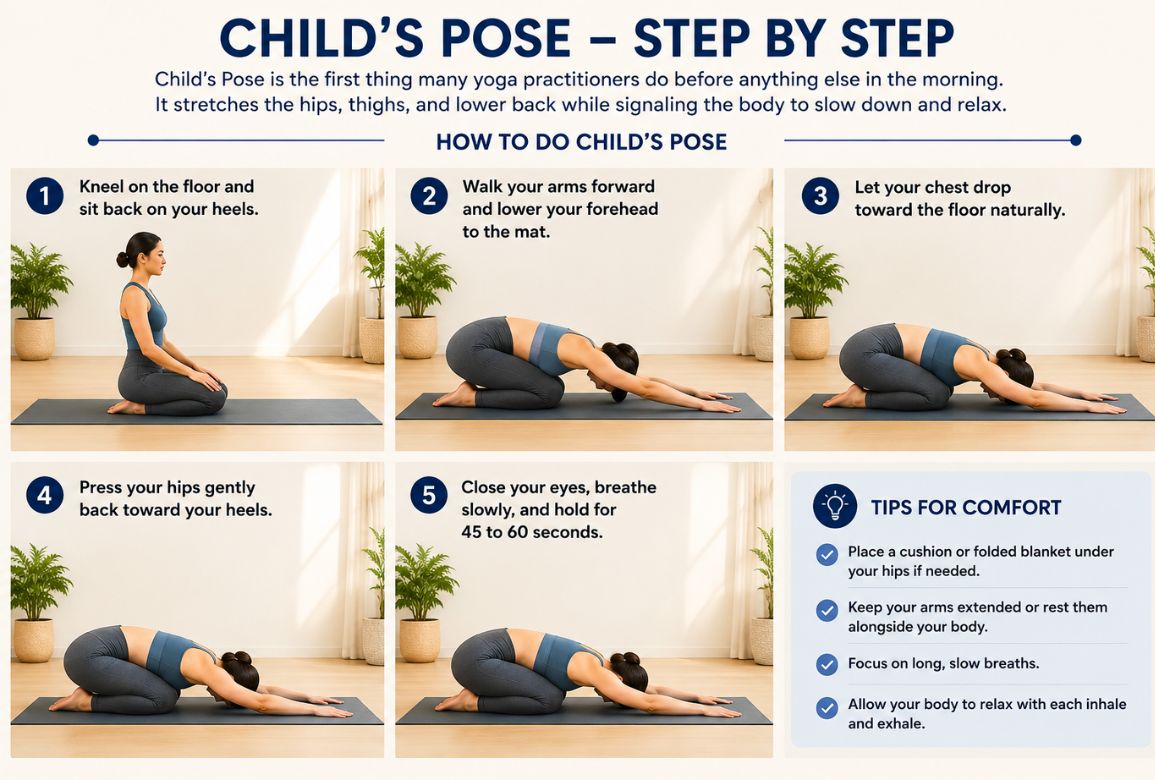
Child’s Pose is the first thing many yoga practitioners do before anything else in the morning. The body just woke up, the hips are tight, and the lower back feels heavy. This single pose addresses all of it at once. It stretches the hips, thighs, and lower back while signaling the body to slow down and relax.
How to do it:
- Kneel on the floor and sit back on your heels
- Walk your arms forward and lower your forehead to the mat
- Let your chest drop toward the floor naturally
- Press your hips gently back toward your heels
- Close your eyes, breathe slowly, and hold for 45 to 60 seconds
Want to see how this pose looks? Watch: Child’s Pose for Beginners
Benefits
- The lower back begins to feel less stiff and more at ease
- Tension in the thighs and groin releases with each breath
- Breath slows down naturally, which relaxes the whole body
- Sets a calm tone before moving into deeper stretches
Common Mistakes
- Letting the knees spread too wide shifts the stretch away from the hips and lower back
- Lifting the forehead off the mat and losing the spinal length
- Holding tension in the shoulders, let them drop completely
- Rushing the hold, under 30 seconds this pose does very little
- Forgetting to breathe deeply, the release comes from the breath, not the position
2. Cat-Cow Stretch
If Child’s Pose wakes up the hips, Cat-Cow wakes up the spine. It is one of the simplest movements in yoga but the results are immediate. Two opposite motions, rounding and arching, work through every vertebra from the neck down to the tailbone. Most people feel looser after just five or six rounds.
Begin on all fours:
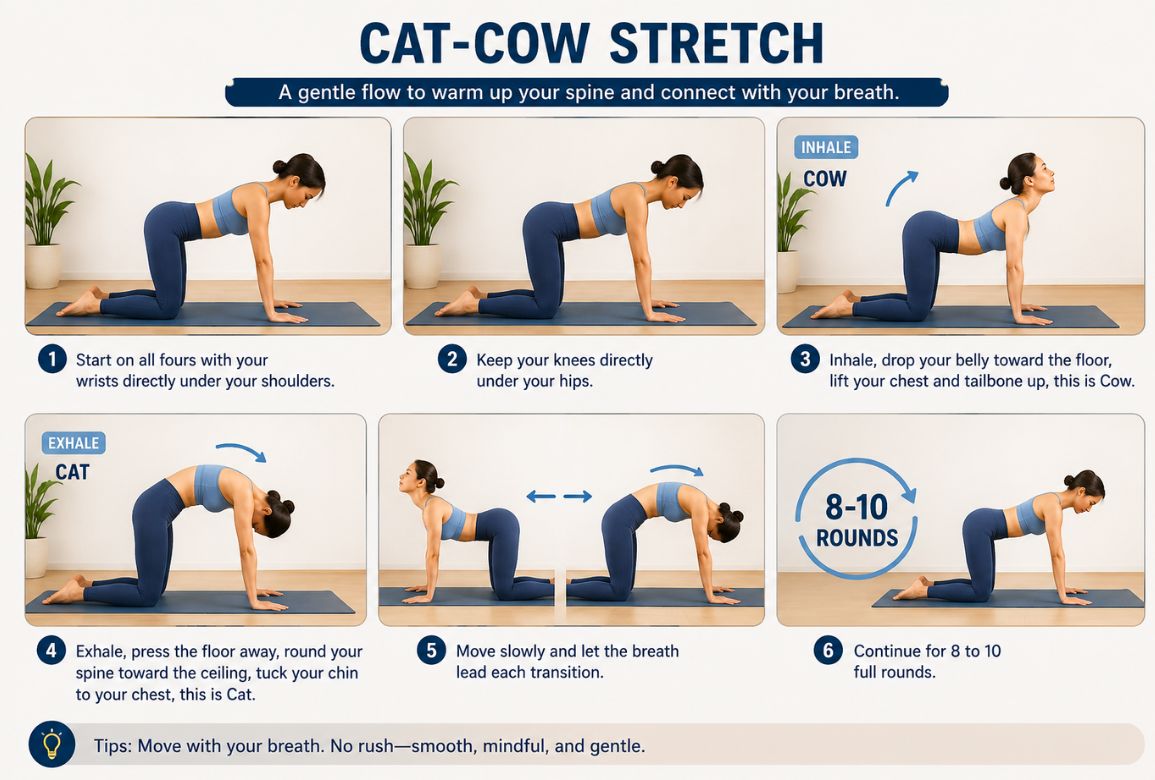
- Start on all fours with your wrists directly under your shoulders.
- Keep your knees directly under your hips.
- Inhale, drop your belly toward the floor, lift your chest and tailbone up, this is Cow.
- Exhale, press the floor away, round your spine toward the ceiling, tuck your chin to your chest, this is Cat.
- Move slowly and let the breath lead each transition.
- Continue for 8 to 10 full rounds.
Not sure about the movement? See it in video: Cat-Cow Stretch Tutorial
Benefits of Cat-Cow Stretch
- Every section of the spine gets direct movement and attention.
- Morning stiffness in the mid and upper back clears up quickly.
- The breath and movement connection builds body awareness over time.
- Prepares the spine for every pose that follows in the routine.
Common Mistakes
- Rushing through the rounds breaks the breath connection and reduces the benefit.
- Only moving the lower back while the upper spine stays stiff limits the stretch significantly.
- Letting the head drop without intention, the neck should follow the spine naturally.
- Holding the stomach tight prevents the belly from softening fully on the inhale.
3. Downward Facing Dog
Most people know this pose by name even before they try yoga. It looks straightforward but there is a lot happening at once. The entire back of the body, from the heels up through the calves, hamstrings, and spine, gets a deep stretch in one position. For a stiff morning body, few poses deliver this much in this little time.
Press the floor away and lift:
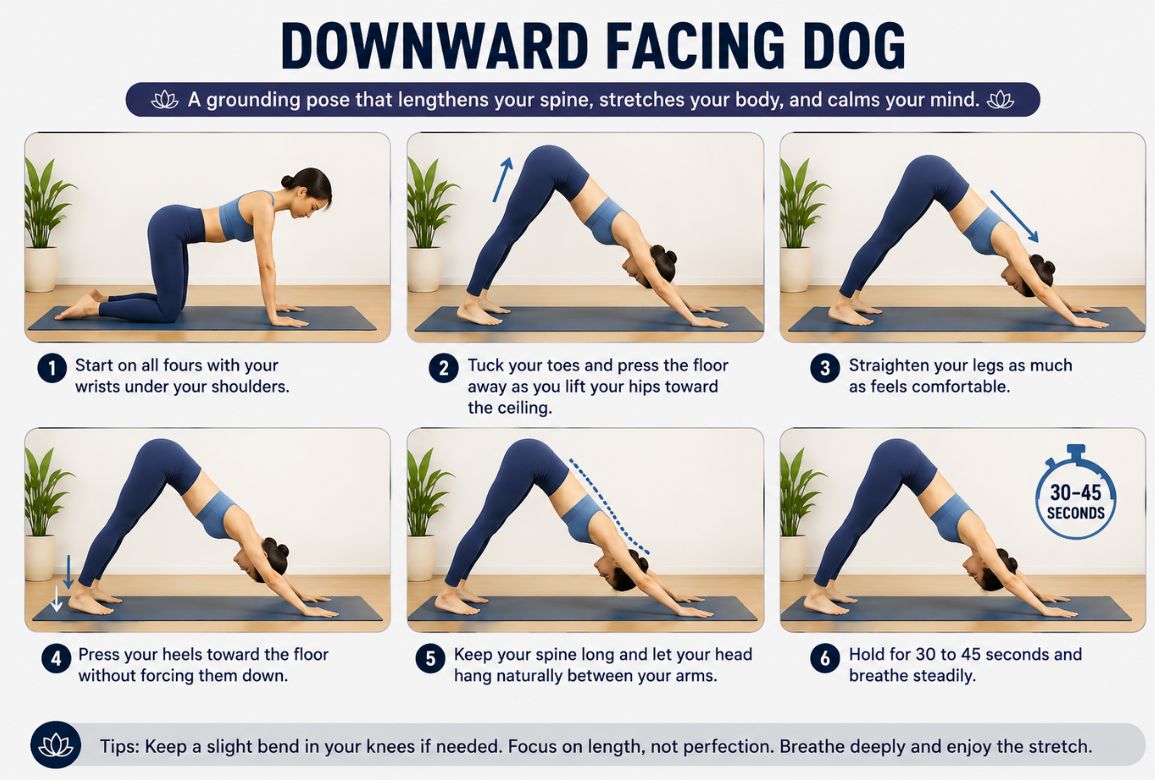
- Start on all fours with your wrists under your shoulders.
- Tuck your toes and press the floor away as you lift your hips toward the ceiling.
- Straighten your legs as much as feels comfortable.
- Press your heels toward the floor without forcing them down.
- Keep your spine long and let your head hang naturally between your arms.
- Hold for 30 to 45 seconds and breathe steadily.
Form matters here, watch before you try: Downward Dog for Beginners
Benefits
- Stretches the hamstrings, calves, and spine all at once.
- Decompresses the back after hours of stillness during sleep.
- Builds shoulder stability alongside lower body flexibility.
- Creates full body awareness early in the morning.
Common Mistakes
- Rounding the lower back to force the legs straight limits the spinal stretch significantly.
- Letting the shoulders collapse inward reduces the benefit for the upper body.
- Locking the knees when hamstrings are tight adds unnecessary strain to the joints.
- Holding the breath instead of breathing steadily through the hold..
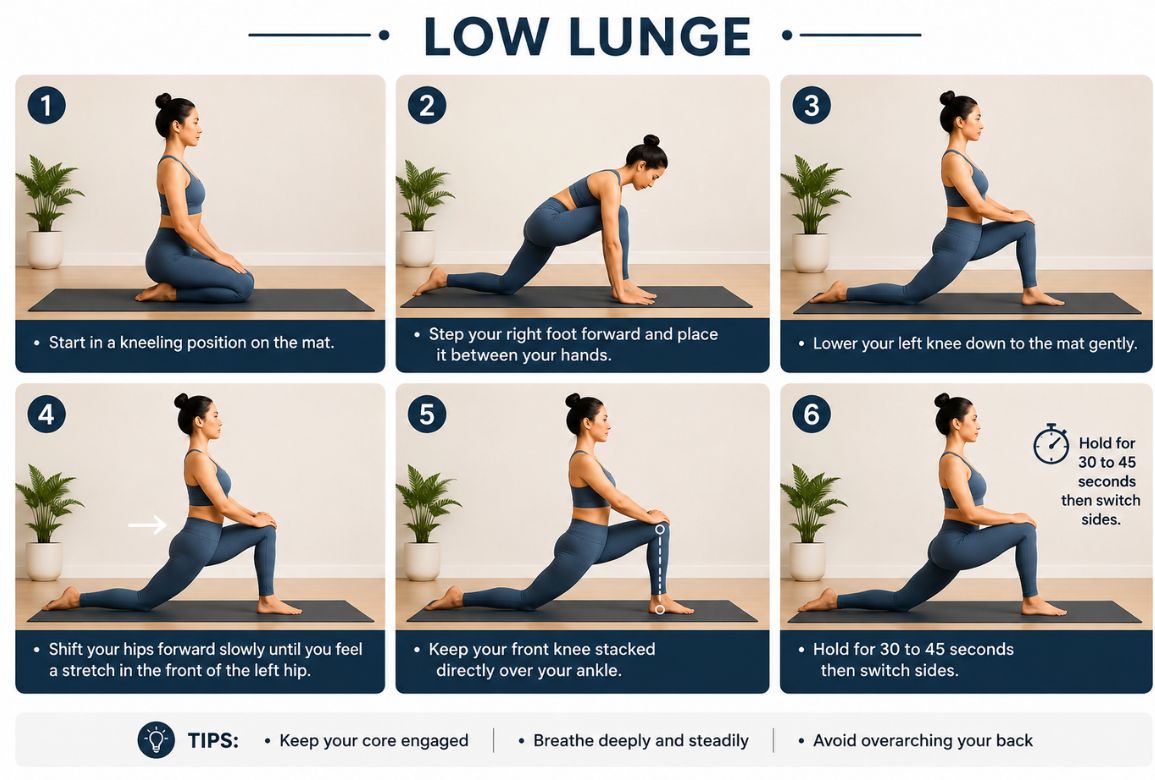
4. Low Lunge
Hip flexors are among the tightest muscles in the body, and overnight they tighten even further. The Low Lunge targets this area directly and opens up the front of the hip in a way most other poses simply cannot reach.
Step forward and sink in:
- Start in a kneeling position on the mat.
- Step your right foot forward and place it between your hands.
- Lower your left knee down to the mat gently.
- Shift your hips forward slowly until you feel a stretch in the front of the left hip.
- Keep your front knee stacked directly over your ankle.
- Hold for 30 to 45 seconds then switch sides.
Hip placement can be tricky. See the correct form here: Low Lunge Video Tutorial
Tight hips are a bigger issue for you? Read: Morning Yoga for Tight Hips and Hamstrings
Benefits of Low Lunge
- Opens the hip flexors and inner thighs with regular practice.
- Counteracts the tightness that builds from prolonged sitting.
- Improves hip mobility for walking, running, and climbing stairs.
- Makes deeper poses more accessible as the routine continues.
Common Mistakes
- Letting the front knee drift past the toes puts unwanted pressure on the joint.
- Not shifting the hips far enough forward reduces the stretch in the back hip significantly.
- Rushing the hold prevents the hip flexors from releasing fully.
- Forgetting to switch sides and working only one hip.
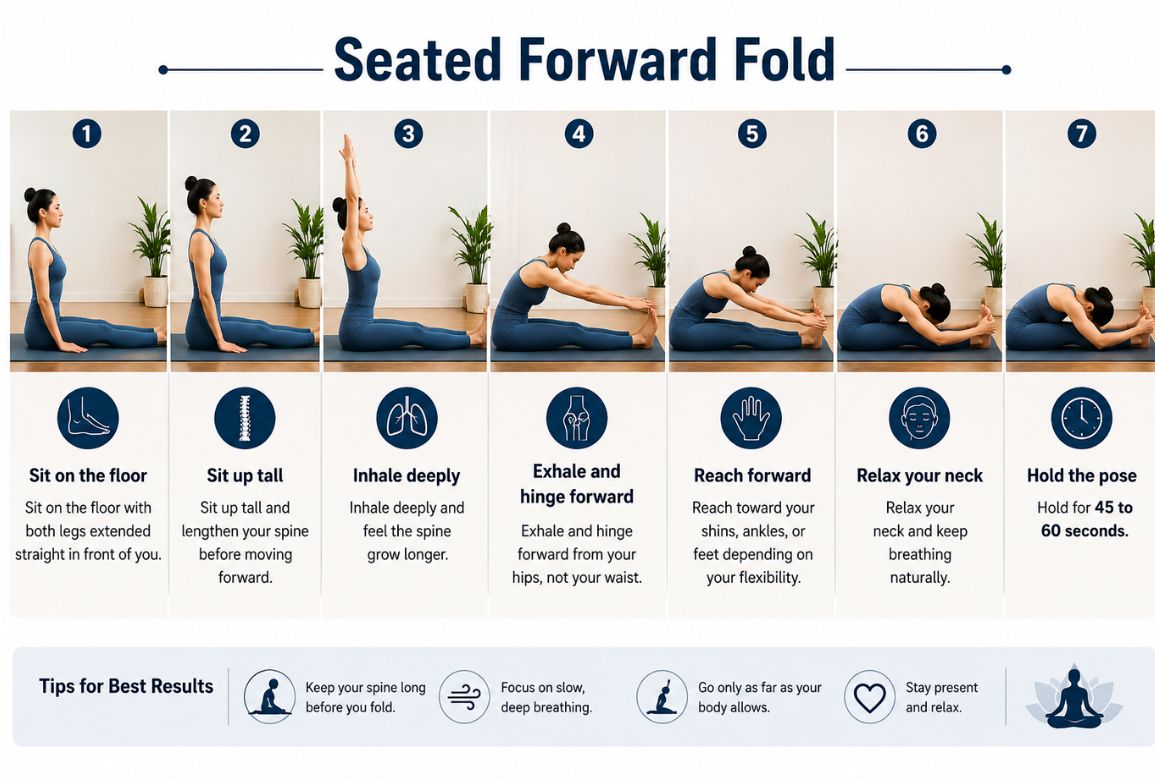
5. Seated Forward Fold
The Seated Forward Fold looks passive from the outside. In practice, it creates one of the deepest stretches available for the hamstrings and lower back. The key is in how you enter it. Most people fold from the waist and miss the point entirely. Folding from the hips changes everything.
Sit tall and hinge forward:
- Sit on the floor with both legs extended straight in front of you.
- Sit up tall and lengthen your spine before moving forward.
- Inhale deeply and feel the spine grow longer.
- Exhale and hinge forward from your hips, not your waist.
- Reach toward your shins, ankles, or feet depending on your flexibility.
- Relax your neck and hold for 45 to 60 seconds.
Not sure how far to fold? Watch this first: Seated Forward Fold Guide
Benefits
- Builds real hamstring length over time.
- Releases tension that accumulates in the lower back overnight.
- Teaches the hip hinge movement pattern that protects the spine long term.
- Calms the nervous system through the extended hold.
Common Mistakes
- Rounding the back immediately instead of hinging from the hips reduces the hamstring stretch.
- Pulling aggressively on the feet creates strain rather than release.
- Expecting immediate results leads to disappointment this pose builds slowly and rewards patience.
- Letting the legs roll outward instead of keeping toes pointing straight up.
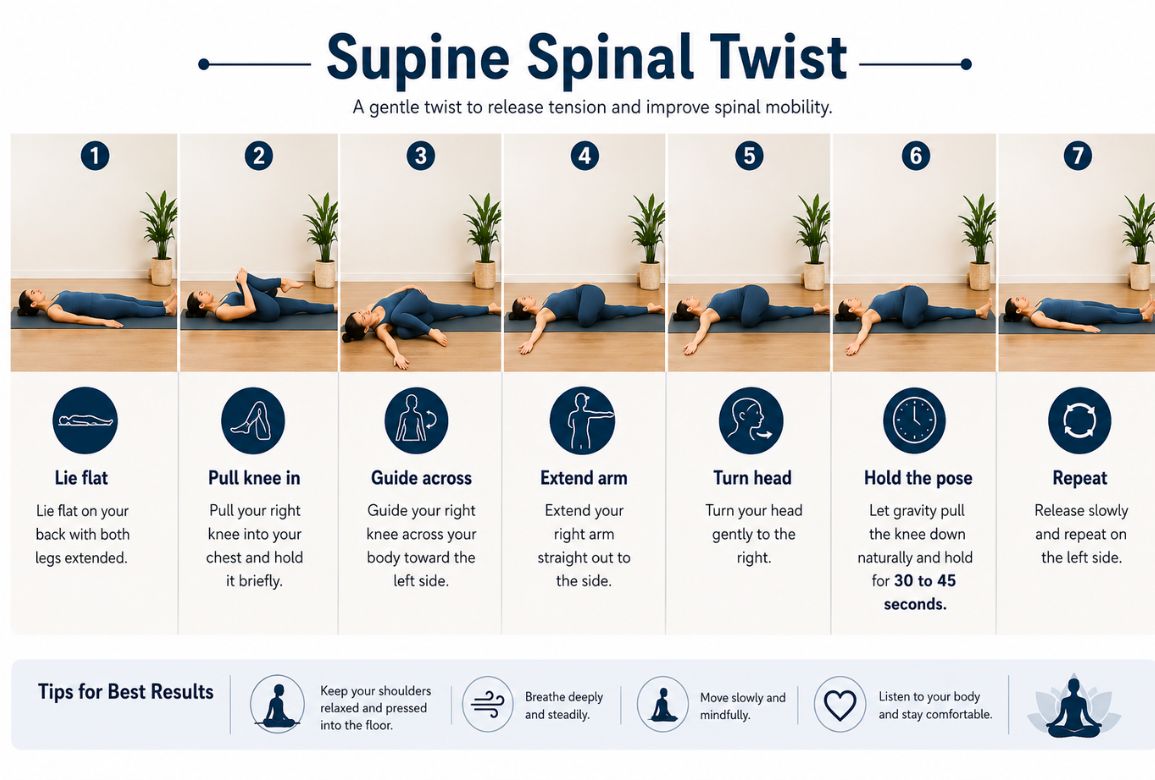
6. Supine Spinal Twist
The Supine Spinal Twist earns its place as the final pose in this routine. By this point the body is warmer and more open. This pose takes advantage of that. It targets the lower back, outer hips, and spinal rotation all at once. Most people feel immediate relief the moment they settle into it.
Lie back and let gravity work:
- Lie flat on your back with both legs extended.
- Pull your right knee into your chest and hold it briefly.
- Guide your right knee across your body toward the left side.
- Extend your right arm straight out to the side.
- Turn your head gently to the right.
- Let gravity pull the knee down naturally and hold for 30 to 45 seconds.
- Release slowly and repeat on the left side.
Want to check your alignment? See it here: Supine Spinal Twist Tutorial
Benefits of Supine Spinal Twist
- Lower back tension releases almost immediately in this position.
- Spinal rotation improves with regular practice.
- Outer hips and glutes get a passive stretch without any effort.
- Ends the session on a deeply relaxing note.
Common Mistakes
- Forcing the knee all the way to the floor instead of letting it rest naturally.
- Lifting the opposite shoulder off the mat and losing the spinal rotation.
- Skipping the second side and only twisting in one direction.
- Rushing out of the pose before the body has time to fully release.
This pose does not demand effort. It simply asks you to lie back, breathe, and let the body unwind. That is exactly how a morning practice should end.
Tips for Improving Flexibility Safely
Flexibility does not come from pushing harder. It comes from showing up consistently and letting the body adapt at its own pace. The people who make the fastest progress are not the ones forcing deep stretches on day one. They are the ones who practice gently every single morning without skipping.
Breath is the most underused tool in any stretching routine. Most people hold their breath when a stretch feels intense. That tightens the muscles further and blocks release. Exhaling slowly into each stretch tells the body it is safe to open up. That one habit alone changes how quickly flexibility develops.
Pain and discomfort are not the same thing. A mild pulling sensation during a stretch is normal and expected. Sharp pain is a signal to back off immediately. Working at the edge of discomfort, not beyond it, is where real progress happens. Patience with the process always produces better results than intensity.
New to yoga? Start here: Best Morning Yoga Routine for Complete Beginners
How Long Does It Take to Become More Flexible?
Within the first two weeks of a daily morning flexibility routine, the body starts feeling noticeably looser. That early change comes from the nervous system relaxing, not the muscles lengthening yet. It is a good sign but real flexibility takes a little longer to develop.
Noticeable structural changes typically show up between four and eight weeks of regular daily practice. The lower back and hips tend to open up faster. The hamstrings take more patience. Progress rarely moves in a straight line, but the body is always moving forward. Showing up the next morning is always the most important step.
FAQ
Is gentle morning yoga good for flexibility?
Yes. Morning is one of the best times to stretch because muscles are at their tightest after sleep. A short daily morning routine builds flexibility faster than stretching at any other time of day.
How long should a morning yoga session be for flexibility?
Ten to fifteen minutes is enough for noticeable results. Consistency matters more than duration. A short daily session delivers better results than a long session done once or twice a week.
Can beginners do morning yoga for flexibility?
Absolutely. Every pose in a morning flexibility routine can be modified for beginners. No prior experience is needed. Starting simple and building gradually is the most effective approach for long term results.
How soon will I see flexibility results from morning yoga?
Most people feel looser within the first two weeks. Structural changes in the muscles and joints typically appear between four and eight weeks of regular daily practice.
Do I need equipment for a morning yoga flexibility routine?
A yoga mat is helpful but not required. A carpeted floor works fine for most poses. No special equipment, weights, or gym membership is needed to build real flexibility at home.
Is it okay to do morning yoga every day?
Yes. Gentle yoga is designed for daily practice. Unlike intense workouts, it does not strain the muscles or require recovery days. Daily practice produces the fastest flexibility gains.
Conclusion
Gentle morning yoga for a more flexible body does not require hours of practice or years of experience. It requires ten minutes, a little floor space, and the willingness to show up each morning.
The six poses in this routine work through the whole body systematically, from the hips and spine to the hamstrings and shoulders. Done consistently, this simple full body stretching routine changes how the body feels every single day.
Flexibility is not a talent. It is a result of showing up. Start with one session tomorrow morning and build from there.
Ready to take it further? Read: Complete Morning Yoga Routine for Beginners at Home
Sources & Reference
- Harvard Health – The Ideal Stretching Routine
- Johns Hopkins Medicine – 9 Benefits of Yoga
- Cleveland Clinic – Benefits of Stretching
- Yoga Journal – Yoga Poses Library
Editorial Note: This content is intended for educational and general wellness purposes. Individual flexibility, mobility, and physical comfort levels may vary based on experience, lifestyle, and consistency of practice.
Reviewed & Updated By: YOGA FLEX ZONE Editorial Team